
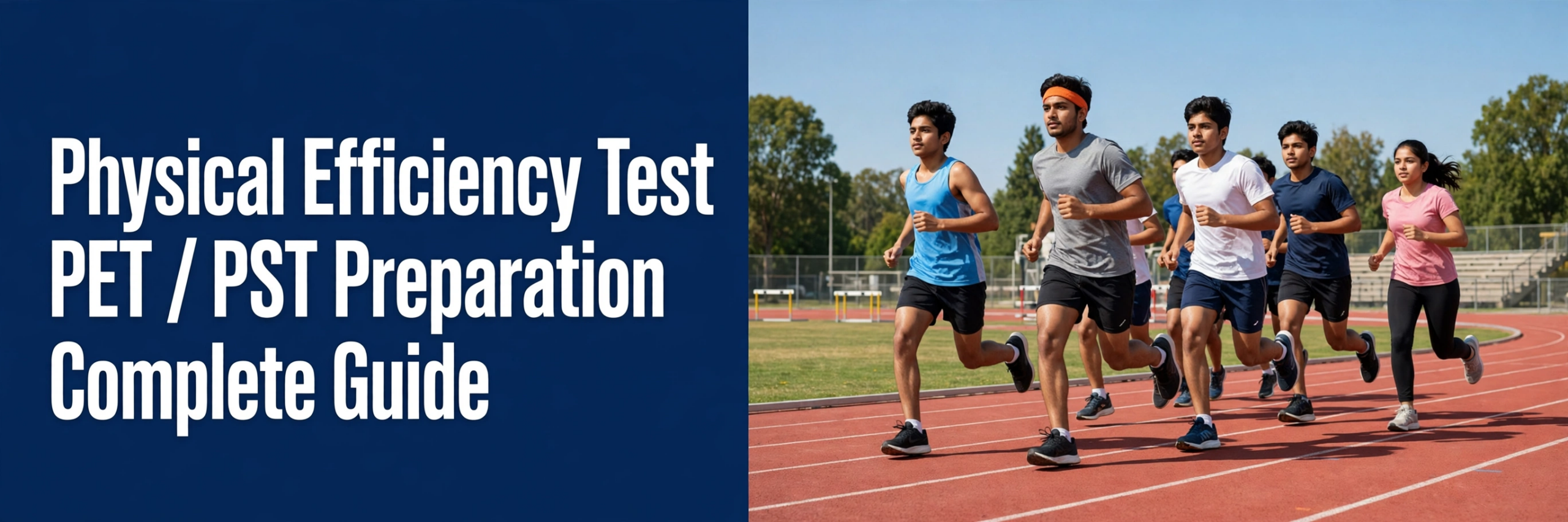
How to Prepare for a Physical Efficiency Test (PET/PST): Running, Height, Chest and Medical Standards
A Physical Efficiency Test (PET) and a Physical Standard Test (PST) are the two physical stages in many uniformed government recruitments.
PET checks what your body can do, usually through running, long jump and similar events. PST checks what your body measures, such as height, weight and chest.
Both stages are qualifying in most recruitments, which means you only need to pass them. Even so, a failed PET or PST can end your selection journey at that very stage.
This guide explains how both tests generally work and how to prepare for them. Standards vary by recruitment, so always check the official notification for the exact figures that apply to you.
What Is PET and PST?
PET is a test of physical ability. Common events include a timed run, long jump, high jump, shot put and, in some recruitments, swimming.
Each event usually has a qualifying mark or a time limit. Candidates who miss the mark in any event are generally not allowed to continue.
PST is a test of physical measurements. Officials measure your height, weight and, for male candidates in many recruitments, chest size.
These measurements are taken with standard instruments, in the presence of officials. The figures are recorded, and candidates outside the required range are usually rejected.
PET and PST often happen on the same day or on consecutive days. A medical examination usually follows for candidates who clear both stages.
Running Events: How to Train
Running is the most common PET event, and it is also the one candidates fail most often. The distance is usually 1.6 km or 5 km, but the exact distance and time limit vary by recruitment.
Start training at least eight weeks before the test if you can. Begin with slow, steady runs of 20 to 30 minutes, three or four times a week.
Add one longer run each week to build stamina. Increase your distance or time by only about ten percent per week to avoid injury.
Once you can run comfortably, add interval training. Run fast for one minute, then jog slowly for two minutes, and repeat this six to eight times.
Practise running at the same time of day as your test, if you know it. Morning tests feel very different from evening practice sessions.
Wear the same shoes you will use on test day during your final practice runs. New shoes on test day can cause blisters and slow you down.
Do not forget strength work. Bodyweight exercises such as squats, lunges, push-ups and planks help your legs and core stay strong through a long run.
Rest is part of training, not a break from it. Take at least one full rest day each week so your muscles recover and grow stronger.
For long jump and high jump, practise the technique, not just the distance. A good run-up, a strong take-off and a clean landing matter more than raw effort.
Height and Chest Measurement
Height is measured barefoot, standing straight against a stadiometer. Keep your heels together, look straight ahead, and breathe normally while the measurement is taken.
Do not try tricks to appear taller, such as standing on your toes or lifting your heels. Officials watch closely, and such attempts can lead to disqualification.
Chest measurement, where it applies, is usually taken twice: once normally and once after a deep breath in. The difference between the two readings is called chest expansion.
Regular breathing exercises and chest-expanding workouts, such as push-ups, pull-ups and swimming, can improve your expansion over a few weeks.
Weight is also checked in many recruitments, and it is often judged against your height. A balanced diet and regular exercise are the only safe ways to reach the required range.
Measurements are usually taken only once, so there is little room for error. Arrive calm, stand naturally, and let the officials do their work.
Medical Standards
The medical examination checks your general fitness for service. Doctors usually test eyesight, hearing, blood pressure, heart and lung function, and overall physical health.
Eyesight standards vary by recruitment. Some allow spectacles, while others require a minimum unaided vision, so read the notification carefully before you apply.
Common disqualifiers include colour blindness (in some forces), flat feet, knock knees, varicose veins, hernia, and untreated ear or dental problems.
Many of these conditions can be treated or improved with time. If you know of a problem, consult a doctor well before the test instead of waiting until the last week.
Avoid crash diets, unproven supplements and painkillers before the test. They can harm your performance and may even show up in medical checks.
A Simple 8-Week Preparation Plan
The plan below suits a healthy beginner with eight weeks to prepare. If you have less time, follow the same order but shorten each stage.
| Week | Focus | Key Sessions |
|---|---|---|
| 1 | Base fitness | 3 easy runs of 20 minutes plus bodyweight strength |
| 2 | Build stamina | 3 runs of 25 minutes plus one long slow run |
| 3 | Add intervals | 2 easy runs, 1 interval session and strength work |
| 4 | Jump practice | 2 runs plus long jump and high jump technique drills |
| 5 | Speed work | 1 interval session, 1 tempo run and strength work |
| 6 | Test simulation | Timed trial run at test distance plus jump practice |
| 7 | Peak week | 2 moderate runs, light strength and good rest |
| 8 | Taper | 2 short easy runs and full rest two days before the test |
Test-Day Checklist
Keep everything ready the evening before the test. A calm morning starts with preparation done the night before.
- Reach the venue at least one hour early.
- Carry your admit card and a valid photo ID.
- Carry the documents listed in your call letter, in original and photocopy.
- Wear comfortable running shoes and light sports clothes.
- Carry water and a light snack such as a banana.
- Warm up for at least 10 to 15 minutes before your event.
- Sleep well the night before; avoid late-night travel.
- Follow the officials’ instructions at every stage.
Common Mistakes to Avoid
Starting training only a week before the test is the most common mistake. Fitness cannot be built in a few days, and sudden intense training causes injuries.
Skipping warm-ups and cool-downs is another common error. Cold muscles tear easily, and a pulled muscle on test day can end your attempt.
Many candidates eat a heavy meal just before running. Eat a light meal two to three hours before the test, and avoid oily or spicy food.
Do not copy someone else’s training plan blindly. Your age, weight and fitness level are different, so adjust the intensity to suit your own body.
Finally, never use performance-enhancing substances. They are unsafe, they can be detected in medical checks, and they can end your career before it starts.
Related Government Jobs
How to Prepare for Government Job Exams: A Beginner’s Study Plan
How to Prepare for Government Job Interviews: Questions, Dress Code and Confidence
UKSSSC Police Constable Recruitment 2026: 1,694 Posts

Suraj is a career content writer at SrJobHut, covering government jobs, private jobs, internships, and recruitment updates. He focuses on providing clear, useful, and easy-to-understand information to help job seekers explore career opportunities.




1 thought on “How to Prepare for a Physical Efficiency Test (PET/PST): Running, Height, Chest and Medical Standards”