How to Read Your Government Job Pay Slip: Basic Pay, DA, HRA and Deductions
Your first pay slip can look confusing. It has many lines, short codes, and numbers that seem to come from nowhere.
This guide explains every part of a government pay slip in plain language. Once you know the parts, you can read any month’s slip in a minute.
The exact format varies by department and by the payroll software used. The components, however, stay broadly the same across government service.
What Is a Pay Slip?
A pay slip is the monthly statement of your salary. It shows what you earned, what was deducted, and what was actually paid to you.
It is issued every month, usually with your salary credit. Many departments now issue it online through a payroll portal.
Keep every pay slip safely. It is proof of income for loans, tax filing, and service records.
The Three Big Numbers: Gross, Deductions, Net
Every pay slip has three headline numbers. Learn them first, and the rest falls into place.
Gross pay is the total of your basic pay and all allowances. It is the amount before any deduction.
Total deductions are the amounts taken out of your gross pay. These include pension contribution, tax, and other recoveries.
Net pay is what reaches your bank account. It is gross pay minus total deductions.
If your net pay suddenly drops, check the deductions section first. Most surprises live there, not in the allowances.
Basic Pay and Pay Level
Basic pay is the core of your salary. Every other allowance is linked to it in some way.
Your basic pay sits in a pay level in the pay matrix. Your post and your years of service decide the level and the cell.
Each year, your basic pay usually rises by one annual increment. This increment is added on a fixed date in the year.
On promotion, you move to a higher pay level. Your basic pay is then fixed in that higher level.
Check that your basic pay matches your appointment or promotion order. A wrong basic pay affects every allowance linked to it.
Dearness Allowance (DA)
Dearness Allowance, or DA, protects your pay against rising prices. It is paid as a percentage of your basic pay.
The DA rate is revised from time to time by the government. It rises when the cost of living rises.
Check the DA rate printed on your slip against the current announced rate. Old rates sometimes linger after a revision.
House Rent Allowance (HRA)
House Rent Allowance, or HRA, is paid if you do not live in government accommodation. It helps with your rent.
HRA is also paid as a percentage of basic pay. The percentage depends on the category of the city where you are posted.
Bigger cities carry a higher HRA rate than smaller towns. Your posting city, not your home town, decides the rate.
Transport Allowance and Other Allowances
Transport Allowance is paid to meet your daily travel cost. It is usually a fixed monthly amount linked to your pay level.
Some posts carry special allowances for the nature of the work. These may include risk allowance, hardship allowance, or shift allowance.
Deductions: Where Your Money Goes
Deductions are the lines that reduce your gross pay. Most of them are compulsory, so learn what each one is.
The National Pension System, or NPS, contribution is the biggest deduction for most new recruits. Both you and the government contribute to it.
Older employees under the old pension scheme see a General Provident Fund, or GPF, deduction instead. GPF is your own savings fund.
Income tax is deducted at source every month, based on your estimated annual income. This is called TDS.
Other deductions may include a licence fee for government quarters, a loan recovery, or a subscription to a staff welfare fund.
An Illustrative Example Pay Slip
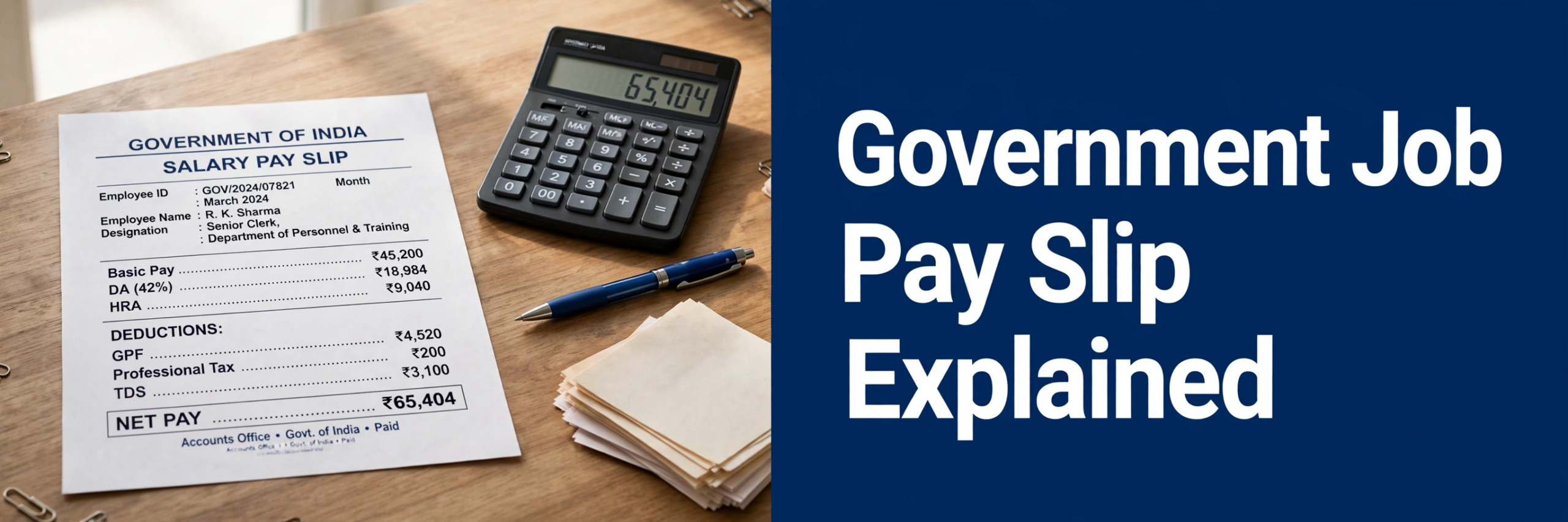
The table below is an ILLUSTRATIVE EXAMPLE ONLY. It uses round numbers to show how a pay slip adds up.
It is not a real employee’s pay slip, and the figures are not the pay of any particular post. Your own figures will differ.
| Pay Slip Item | Amount (Rs) | Notes |
|---|---|---|
| Basic Pay | 35,400 | Core pay in the pay level |
| Dearness Allowance (DA) | 17,700 | Shown at 50% of basic pay for illustration only |
| House Rent Allowance (HRA) | 9,558 | Shown at 27% of basic pay for illustration only |
| Transport Allowance | 3,600 | Fixed amount for illustration only |
| Gross Pay | 66,258 | Basic pay plus all allowances |
| NPS contribution (employee share) | 5,310 | Shown at 10% of basic pay plus DA for illustration only |
| Income tax (TDS) | 2,000 | Illustrative monthly figure only |
| Professional tax | 200 | Illustrative monthly figure only |
| Total Deductions | 7,510 | All deductions added together |
| Net Pay | 58,748 | Gross pay minus total deductions |
Read your own slip the same way. Add the earnings, add the deductions, and check that gross minus deductions equals net pay.
How to Spot Errors in Your Pay Slip
Pay slip errors are not rare, and they are easier to fix when caught early. Check your slip every month.
First, check your basic pay against your last order. A missed increment or promotion is the most costly error.
Second, check the DA and HRA rates. Compare them with the current announced rates for your city category.
Third, check that allowances you are entitled to are present. A missing transport or special allowance adds up over months.
Fourth, check every deduction. Look for a recovery or loan deduction you do not recognise.
Fifth, check the totals. Gross minus deductions must equal the net pay credited to your bank.
What to Do If You Find an Error
Note the error in writing with the month and the line involved. Keep a copy of the pay slip showing it.
Raise it first with your drawing and disbursing officer or the accounts section. Most errors are fixed at that level.
If it is not fixed, write to the head of office through proper channel. Attach the pay slip and the order that supports your claim.
Pay Slip Checklist for Every Month
Use this short checklist each time a new pay slip arrives. It takes two minutes and catches most problems early.
| Check | What to Look For |
|---|---|
| Basic pay | Matches your appointment or promotion order |
| DA rate | Matches the current announced rate |
| HRA rate | Matches your posting city’s category |
| Allowances | Every allowance you are entitled to is present |
| NPS or GPF | Deduction is present and at the right amount |
| Income tax | TDS looks reasonable for your income |
| Net pay | Gross minus deductions equals the bank credit |
Final Advice
Your pay slip is not just a receipt. It is a monthly health check on your salary and your service record.
Read it every month, keep it filed, and question anything that looks wrong. Small errors caught early stay small.
Related Government Jobs
- Government Job Salary, Allowances and Perks Explained: Pay Levels, DA, HRA and Pension
- What to Do After Selection: Joining Formalities, Medical Test and Training
- How to Prepare for Government Job Interviews: Questions, Dress Code and Confidence

Suraj is a career content writer at SrJobHut, covering government jobs, private jobs, internships, and recruitment updates. He focuses on providing clear, useful, and easy-to-understand information to help job seekers explore career opportunities.