
Government Job vs Private Job: Salary, Security and Growth Compared
Every year, lakhs of young Indians face the same question.
Should I prepare for a government job or take a private job?
Both paths can build a good career, but they work very differently.
This guide compares salary, security, and growth honestly, side by side.
Why This Comparison Matters
A career choice shapes your income, your daily routine, and your future.
Many people choose only by hearing what others say.
Some say government jobs are slow and boring.
Others say private jobs are stressful and unsafe.
The truth is more balanced than either view.
Understanding them before you choose saves years of regret later.
Starting Salary and In-Hand Pay
Government starting salaries follow fixed pay levels under the 7th Pay Commission.
A new recruit knows the basic pay before joining.
For example, a starting salary of around Rs 30,000 a month is a typical illustrative figure for an entry-level post.
The exact figure depends on the post, the pay level, and the city.
Private starting salaries vary much more widely.
A fresher in a small firm may earn less than a government clerk.
A fresher in a top company may earn far more than a government officer.
Government pay is steady and rises on a fixed schedule.
Private pay can rise fast, but it depends on performance and the market.
Allowances and Perks
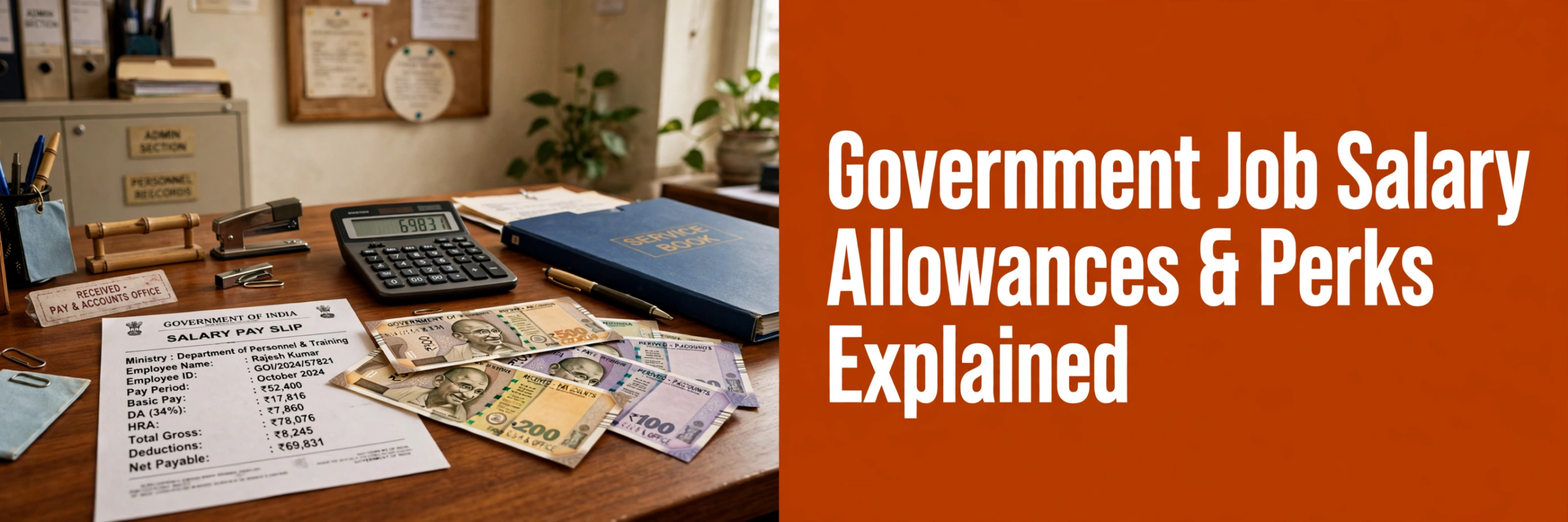
Government jobs add allowances on top of basic pay.
Dearness Allowance (DA) rises with inflation, usually twice a year.
House Rent Allowance (HRA) depends on the city where you are posted.
Many posts also offer medical facilities and leave travel concession.
Pension is a major long-term benefit of government service.
Most new government employees are covered under the National Pension System (NPS).
Private jobs offer a different set of benefits.
Provident Fund (PF) and gratuity are common in organised private firms.
Some companies add health insurance, bonuses, and stock options or ESOPs.
However, private perks depend entirely on the employer.
A small firm may offer almost no benefits beyond salary.
Job Security and Termination
Job security is the biggest reason people choose government jobs.
Once confirmed, a government employee is rarely removed from service.
Termination needs a formal process, with enquiry and a chance to respond.
Recessions and company losses do not usually affect government jobs.
Private jobs carry a real risk of layoffs.
Companies cut staff when profits fall or a project ends.
Even strong performers can lose their jobs in a downturn.
If stability matters most to you, government service wins clearly.
If you can handle risk, the private sector may suit you better.
Work-Life Balance and Transfers
Government jobs usually have fixed working hours.
Most offices run five or six days a week, with clear leave rules.
Weekends and public holidays are generally protected.
Transfers are a part of government service.
You may be posted to a new city or district every few years.
Private jobs often demand longer hours, especially in growing companies.
Deadlines, clients, and targets can stretch the working day.
But private jobs usually let you stay in one city if you choose.
Work from home is also more common in the private sector.
Promotions and Growth Speed
Government promotions follow seniority and departmental exams.
They are slow but predictable for most employees.
Fast promotion is possible through departmental exams, but it is not common.
Private promotions depend on performance and results.
A strong performer can get two promotions in three years.
A weak performer may stay in the same role for years.
Salary growth shows the same pattern.
Government pay rises steadily through increments and DA revisions.
Private pay can jump sharply with a promotion or a job change.
Skill Growth and Switching Jobs
Private jobs usually build marketable skills faster.
You learn new tools, work on varied projects, and face changing demands.
Switching companies is normal and often brings a salary hike.
Government jobs build deep knowledge of rules, systems, and public service.
Leaving a government job mid-career is a big decision.
You give up seniority, pension benefits, and job security.
Private careers reward people who keep learning and moving.
Ask yourself which kind of growth excites you more.
Government vs Private: At a Glance
This table sums up the main differences in one place.
| Factor | Government Job | Private Job |
|---|---|---|
| Starting salary | Fixed by pay level, known in advance | Varies widely by company and skills |
| Salary growth | Steady, through increments and DA | Fast for top performers, uneven for others |
| Allowances and perks | DA, HRA, medical, NPS pension | PF, gratuity, insurance, bonuses, ESOPs |
| Job security | Very high after confirmation | Depends on company health and market |
| Work-life balance | Mostly fixed hours and clear leave rules | Often longer hours, more flexibility |
| Transfers | Regular postings to new places | Usually stay in one city if you choose |
| Promotions | Slow, seniority-based, predictable | Fast for performers, performance-based |
| Skill growth | Deep knowledge of rules and systems | Fast, marketable, project-based skills |
| Switching jobs | Hard to leave mid-career | Normal, and often brings a pay hike |
| Retirement benefits | Pension through NPS and gratuity | PF, gratuity, and personal savings |
Who Should Choose Which Path
There is no single right answer for everyone.
Your personality, goals, and situation should decide.
Choose a Government Job If You
Value stability and a steady income above everything else.
Want fixed hours and time for family and personal life.
Are comfortable with transfers to different cities.
Can prepare patiently for competitive exams over months or years.
Want a pension and long-term security after retirement.
Choose a Private Job If You
Want fast salary growth and quick promotions.
Enjoy learning new skills and changing roles often.
Are comfortable with targets, deadlines, and some risk.
Want to stay in one city and build a career there.
Prefer performance-based rewards over seniority-based ones.
The Decision Checklist
Answer these questions honestly before you decide.
Your answers will point you towards the right path.
| Question | Your Answer |
|---|---|
| Do I need a stable income in the next two years? | ☐ |
| Can I spend a year or more preparing for exams? | ☐ |
| Am I comfortable with transfers to other cities? | ☐ |
| Do I want fast promotions, even with more pressure? | ☐ |
| Is work-life balance more important than high pay? | ☐ |
| Do I enjoy learning new skills and switching roles? | ☐ |
| Can I handle the risk of layoffs in a slow market? | ☐ |
| Do I want pension and retirement security? | ☐ |
If most of your answers favour stability, start preparing for government exams.
If most favour speed and growth, build skills for the private sector.
You can also do both for a while, if your time allows.
Many candidates work in a private job while preparing for exams.
The Honest Truth
Neither path guarantees a happy or successful life.
A government job can feel slow if you love fast growth.
A private job can feel stressful if you need security.
Success comes from matching the career to your own nature.
Look at your goals, your patience, and your risk appetite.
Then commit fully to the path you pick.
That commitment matters more than the choice itself.
Related Government Jobs
Government Job Salary, Allowances and Perks Explained: Pay Levels, DA, HRA and Pension
Government Jobs After Graduation: Complete Guide
How to Prepare for Government Job Exams: A Beginner’s Study Plan

Suraj is a career content writer at SrJobHut, covering government jobs, private jobs, internships, and recruitment updates. He focuses on providing clear, useful, and easy-to-understand information to help job seekers explore career opportunities.