
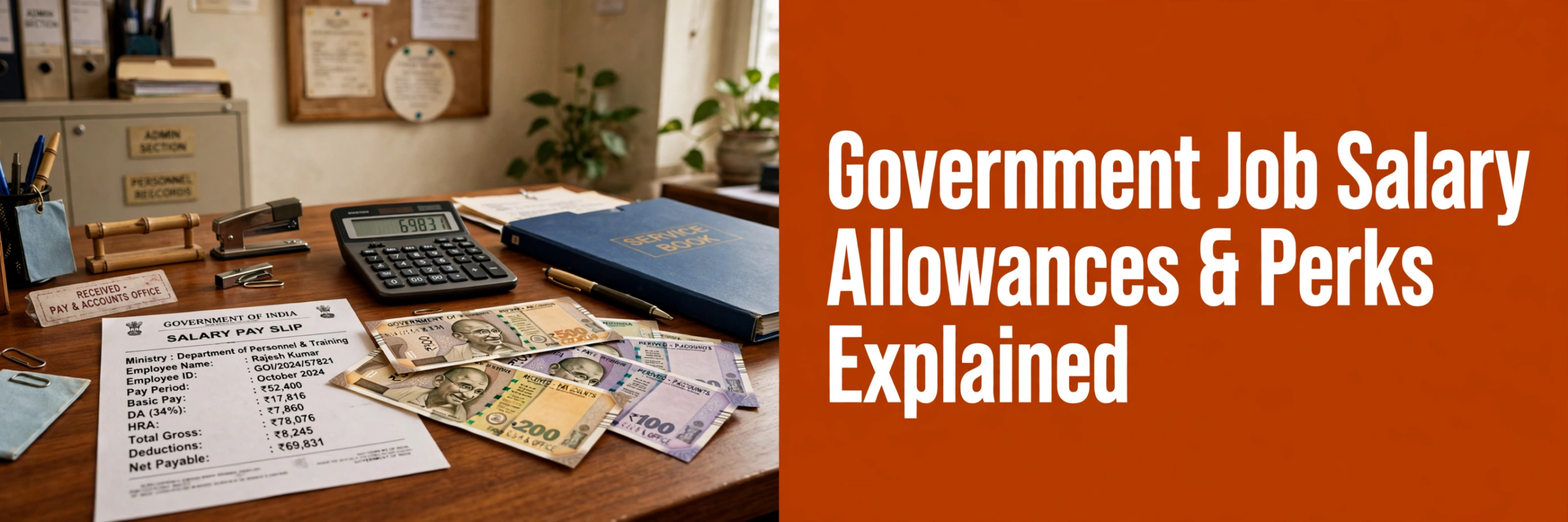
Government Job Salary, Allowances and Perks Explained: Pay Levels, DA, HRA and Pension
A government salary is more than one number. It is a package of basic pay, allowances, and long-term benefits.
Many candidates compare only the starting figure in a notification. That figure rarely tells the full story of what you will earn.
This guide explains how government salaries are structured. It covers pay levels, allowances, pension, and the perks beyond salary.
How Government Salaries Are Structured
Central government salaries follow the 7th Central Pay Commission, known as the 7th CPC. Most states follow a similar structure.
Your total pay has three layers. Basic pay is the fixed core, allowances are added on top, and deductions are taken out.
Basic pay depends on your pay level. Allowances depend on your city, your duties, and the current rates.
The same post can pay differently in two cities. Allowances such as HRA change with the city category, not the post.
Basic Pay vs Gross Salary vs In-Hand Salary
Basic pay is the fixed amount set by your pay level and cell. It is the base on which most allowances are calculated.
Gross salary is basic pay plus all allowances. This is the total before any deductions are made.
In-hand salary is what reaches your bank account. It is gross salary minus deductions such as tax, pension, and other contributions.
Always check which figure a notification quotes. Many notifications state the pay level, not the in-hand salary.
Pay Levels and the Pay Matrix
The pay matrix is a grid that fixes basic pay for every central government post. Each post is placed at one pay level.
Pay levels run from Level 1 to Level 18. Higher levels are for more senior posts with greater responsibility.
Each level has cells, which are steps of basic pay. You move to the next cell with each annual increment.
The figures below are the standard 7th CPC starting basic pay for each level. They are illustrative standard figures, not any one recruitment’s salary.
| Pay Level | Illustrative Starting Basic Pay (7th CPC) | Typical Posts at This Level |
|---|---|---|
| Level 1 | Rs 18,000 | Group C support staff, MTS |
| Level 2 | Rs 19,900 | Lower division clerk, constable |
| Level 3 | Rs 21,700 | Upper division clerk, driver |
| Level 4 | Rs 25,500 | Stenographer, junior assistant |
| Level 5 | Rs 29,200 | Senior assistant, sub-inspector |
| Level 6 | Rs 35,400 | Inspector, senior section officer |
| Level 7 | Rs 44,900 | Section officer, assistant |
| Level 8 | Rs 47,600 | Senior section officer, superintendent |
| Level 9 | Rs 53,100 | Under secretary level posts |
| Level 10 | Rs 56,100 | Group A entry, assistant commissioner |
Your exact basic pay depends on your level and cell. The starting cell is normally the first one in the level.
Annual increments are usually 3 percent of basic pay. They are added once a year, on a fixed date.
Dearness Allowance (DA)
Dearness Allowance, or DA, protects your pay against rising prices. It is calculated as a percentage of basic pay.
DA is linked to the cost of living index. When inflation rises, DA rises too, so your real income is protected.
The rate is revised twice a year, in January and July. The new rate is announced by the government each time.
Because DA changes every six months, no fixed rate can be quoted here. Always check the current rate before estimating your salary.
DA is fully taxable. It is added to basic pay before other allowances and deductions are worked out.
House Rent Allowance (HRA)
House Rent Allowance, or HRA, helps you pay for rented housing. It is calculated as a percentage of your basic pay.
The rate depends on your city category. Cities are grouped as X, Y, or Z, based on population and cost of living.
X cities are the largest metros and carry the highest HRA rate. Y cities are medium cities, and Z cities are smaller towns.
The standard 7th CPC HRA rates are 24 percent for X cities, 16 percent for Y cities, and 8 percent for Z cities. These are standard rates, not a fixed current figure.
If you live in government accommodation, HRA is not paid. A licence fee is charged instead, which is usually much lower than market rent.
HRA is partly tax-free under income tax rules, within set limits. Keep rent receipts and your rental agreement for tax proof.
Transport Allowance
Transport Allowance covers your daily travel to work. It is a fixed monthly amount, based on your pay level and city.
Employees in higher pay levels receive a higher transport allowance. Metro cities also carry a higher rate than smaller towns.
DA is also paid on transport allowance. So the amount rises slightly whenever the DA rate is revised.
Other Allowances
Many posts carry extra allowances linked to the job itself. These vary widely, so always check the notification of the post.
Medical allowance covers basic health costs where no other medical facility is given. Some departments pay it monthly.
Children Education Allowance helps with school fees. It is paid per child, up to two children, within a fixed limit.
Uniform allowance is given where the job needs a uniform. It covers purchase and upkeep of the uniform.
Risk and hardship allowances are paid for difficult postings. These include remote areas, border postings, and hazardous duties.
| Allowance | What It Covers | How It Is Calculated |
|---|---|---|
| Dearness Allowance (DA) | Protection against inflation | Percentage of basic pay, revised twice a year |
| House Rent Allowance (HRA) | Rented housing costs | Percentage of basic pay, by city category X, Y or Z |
| Transport Allowance | Daily travel to work | Fixed monthly amount, by pay level and city |
| Children Education Allowance | School fees for children | Fixed amount per child, up to two children |
| Medical Allowance | Basic health costs | Fixed monthly amount, where applicable |
| Uniform Allowance | Uniform purchase and upkeep | Fixed amount, for uniformed posts |
| Risk and Hardship Allowance | Difficult or hazardous postings | Fixed or percentage amount, by posting type |
Pension: NPS and Old Pension Scheme
Pension is one of the biggest reasons candidates prefer government jobs. It provides income after retirement.
Most employees who joined after 1 January 2004 are covered by the National Pension System, or NPS. This is a contribution-based scheme.
Under NPS, you contribute 10 percent of basic pay plus DA each month. The government adds its own contribution on top.
Your NPS money is invested in the market through pension funds. The final amount depends on contributions and market returns.
At retirement, part of the corpus is paid as a lump sum. The rest buys an annuity, which pays a monthly pension.
The Old Pension Scheme, or OPS, works differently. It pays a fixed pension based on your last drawn basic pay.
Under OPS, the pension was usually 50 percent of the last basic pay after full service. No monthly contribution was needed from the employee.
OPS now applies only to employees who joined before 2004, and to a few specific categories. New recruits join NPS.
Perks Beyond Salary
Government jobs offer benefits that do not appear on a salary slip. These add real value over a full career.
Job security is the best-known perk. A confirmed government employee cannot be removed without a formal process.
Leave benefits are generous. You get earned leave, casual leave, medical leave, and maternity or paternity leave.
Medical facilities are provided through CGHS for central employees. It covers treatment at empanelled hospitals for you and your family.
Leave Travel Concession, or LTC, helps pay for travel during holidays. It covers you and your family, once in a block of years.
Promotions follow a clear path in most departments. Time-bound promotions and departmental exams open higher posts.
Reading Your Salary Slip
A salary slip lists earnings on one side and deductions on the other. The difference between the two is your in-hand pay.
Earnings include basic pay, DA, HRA, transport allowance, and any other allowances. Deductions include NPS, income tax, and professional tax.
The worked example below shows how the parts add up. It is an illustrative example only, not any real recruitment’s salary.
Worked Example: Illustrative Salary Slip
Take a Level 6 employee in a Y-category city, with a starting basic pay of Rs 35,400. DA and HRA rates are illustrative, for explanation only.
Basic pay is Rs 35,400. DA at an illustrative 50 percent adds Rs 17,700 to the total.
HRA at the standard Y-city rate of 16 percent adds Rs 5,664. Transport allowance adds about Rs 3,600, including DA on it.
Gross salary comes to roughly Rs 62,364. Deductions for NPS, tax, and other heads may take about Rs 8,000 to Rs 10,000.
In-hand pay would then be around Rs 52,000 to Rs 54,000. Actual figures vary with the current DA rate and your tax slab.
Related Government Jobs
- Government Job Age Relaxation Rules: SC, ST, OBC, EWS and PwBD Explained
- Government Jobs After Graduation: Complete Guide
- Reservation in Government Jobs Explained: Categories, Certificates and Rules
- Government Job vs Private Job: Salary, Security and Growth Compared
- How to Choose Between Two Government Job Offers
- Government Job Transfers, Promotions and Career Growth Explained

Suraj is a career content writer at SrJobHut, covering government jobs, private jobs, internships, and recruitment updates. He focuses on providing clear, useful, and easy-to-understand information to help job seekers explore career opportunities.






4 thoughts on “Government Job Salary, Allowances and Perks Explained: Pay Levels, DA, HRA and Pension”