How to Prepare for Government Job Interviews: Questions, Dress Code and Confidence
Clearing the written exam is only half the journey. The interview is where the panel meets the real candidate.
A good interview can lift a borderline score, so prepare for it as seriously as the written exam.
This guide explains how government interviews work, what questions to expect, what to wear, and how to stay confident. Follow it, and you will walk in prepared, not nervous.
How Government Job Interviews Work
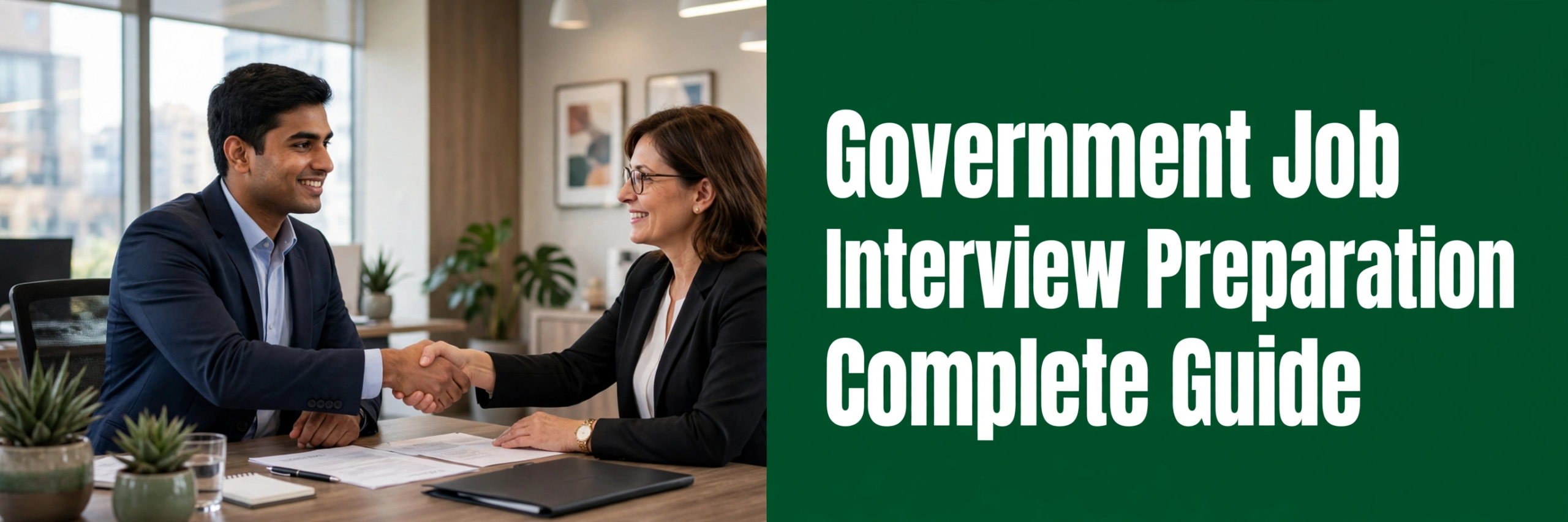
Most government interviews are held by a small panel of two to five members. One member usually leads the questions, while others observe and note your answers.
The panel checks your knowledge, your honesty, and your attitude. It also checks whether you suit a public-facing government role.
Interview marks carry different weight in different recruitments. Always check the official notification of your recruitment for the exact pattern.
Your interview usually starts with your own background. Questions then move to your subject, current affairs, and the job itself.
Stay calm if the panel asks something you do not know. Saying “I am not sure, but I will find out” is better than guessing.
Common Interview Questions and How to Answer Them
Most questions fall into a few fixed groups. Prepare one strong answer for each group, and you will cover most of the interview.
The table below shows what the panel is really checking with each common question.
| Question | What the Panel Is Checking |
|---|---|
| Tell us about yourself | How clearly you present your background and goals |
| Why do you want this job? | Your motivation and understanding of the role |
| What are your strengths? | Self-awareness and honesty about your abilities |
| What is your biggest weakness? | Honesty and whether you are working to improve |
| What is happening in current affairs? | Whether you follow news and understand its meaning |
| Questions from your subject | Whether your degree knowledge is still fresh |
| Why should we select you? | Confidence and a clear reason to choose you |
| What will you do if you are not selected? | Your attitude towards failure and your future plans |
Tell Me About Yourself
Keep this answer short, about a minute long. Start with your education, then your skills, then why this job interests you.
Do not repeat your full resume. Pick the two or three points that matter most for this post.
Example: “I am a graduate from a government college in my district. I have prepared for public service exams for two years. I want this job because I want to serve people directly.”
Why Do You Want This Job?
Link your answer to the work itself, not only to salary or job security. Panels hear “job security” in almost every interview.
Talk about public service, stability with purpose, and the chance to learn. Mention one duty of the post that genuinely appeals to you.
Example: “This post works directly with the public. I want a career where my work helps ordinary people, and this role does exactly that.”
Strengths and Weaknesses
Name a real strength, then give one short example that proves it. Avoid empty claims such as “I am a hard worker” with no proof.
For weakness, choose something genuine but not fatal for the job. Then explain the step you are taking to improve it.
Example: “My strength is that I stay calm under pressure, which I learned while managing college events. My weakness is public speaking, so I have joined a speaking group to practise every week.”
Current Affairs Questions
Read the news daily for at least a month before your interview. Focus on national news, your state, and schemes related to the department.
Do not memorise headlines only. Understand why each event matters and what it changes for ordinary people.
If asked about a topic you know partly, state what you know clearly. Then admit the part you do not know, instead of inventing facts.
Subject Knowledge Questions
Revise the core topics of your degree or diploma. Panels often start with simple basics, then go deeper if you answer well.
Connect your subject to the job wherever you can. This shows you understand the post, not just your textbook.
If a question is outside your subject, say so honestly. The panel respects a clear “I have not studied this area” more than a bluff.
Dress Code for Government Job Interviews
Your dress should be neat, simple, and formal. The panel should notice your answers, not your clothes.
Choose clean, well-ironed clothes in plain colours. Avoid bright colours, loud patterns, and heavy perfume.
For Men
A light-coloured formal shirt with dark trousers is the safest choice. A tie and blazer are optional, not compulsory.
Wear clean formal shoes with dark socks. Keep your hair neat and your face clean-shaven or your beard well trimmed.
For Women
A formal salwar-kameez, a saree, or a formal shirt with trousers all work well. Choose plain or lightly patterned fabric in a sober colour.
Keep make-up light and jewellery minimal. Wear closed, comfortable formal footwear that you can walk in easily.
What to Avoid
Avoid jeans, t-shirts, shorts, and sports shoes. Avoid strong perfume, heavy jewellery, and flashy watches.
Do not wear anything brand new that you have never tried before. Uncomfortable clothes will distract you during the interview.
Documents to Carry
Carry your documents in a neat folder, arranged in the order the call letter lists them. Keep originals and photocopies separate.
Check every document the night before. A missing certificate can cost you the interview, even after a strong performance.
- Interview call letter or admit card, printed clearly.
- Photo identity proof, such as Aadhaar card, voter ID, or driving licence.
- Original certificates for education, starting from Class 10.
- Caste, income, or domicile certificate, if applicable to your category.
- Experience certificates, if you have claimed any experience.
- Two recent passport-size photographs, as asked in the call letter.
- Photocopies of all documents, in the same order as the originals.
- A pen, for signing forms or filling in details at the venue.
Reach the venue with your folder ready. Searching for papers at the gate creates stress before you even enter.
Building Confidence Before the Interview
Confidence comes from preparation, not from talent alone. The more you practise, the calmer you will feel on the day.
Start your preparation at least two weeks before the interview. Daily practice, even for thirty minutes, makes a real difference.
Practise With Mock Interviews
Ask a friend, teacher, or family member to act as the panel. Sit formally, answer aloud, and ask for honest feedback.
Record yourself answering once or twice. Watch for filler words and answers that run too long.
Practise the first question, “Tell us about yourself,” until it sounds natural. A strong start settles your nerves for the rest.
Body Language Matters
Walk in calmly, greet the panel with a smile, and sit only after you are asked. Keep your back straight and your hands still.
Make eye contact with the member who asked the question. Glance at others while answering, but do not stare at the table.
Speak slowly and clearly, at a steady pace. If you feel nervous, pause for a second before answering, instead of rushing.
Handling Tough Questions
Tough questions test your thinking, not your memory. Take a moment, think aloud briefly, and then give your best answer.
If the panel disagrees with you, stay polite and do not argue. You may say, “I understand your point, and this is how I see it,” and explain calmly.
Some questions have no right answer. The panel watches how you reason, not whether you match a fixed reply.
Common Mistakes to Avoid
Most interview failures come from avoidable mistakes. Read this list before your interview day and check yourself against it.
- Memorised answers: a rehearsed speech sounds false. Prepare points, not full scripts.
- Bluffing: guessing at facts you do not know. Panels notice it quickly.
- Talking too much: long answers lose the panel. Answer the question, then stop.
- Negative talk: criticising past employers, teachers, or the system.
- Overconfidence: interrupting members, arguing, or acting as if selection is certain.
- Poor listening: answering before the question is finished, or answering a different question.
- Phone or gadgets: forgetting to switch off your phone before entering the room.
On the Interview Day
Reach the venue early, at least thirty minutes before your reporting time. This gives you time to settle and find the right room.
Check the venue location the day before. Plan for traffic, and keep the call letter and identity proof in your hand, not deep in your bag.
Eat a light meal and carry water. A heavy meal or an empty stomach can both make you uncomfortable.
While waiting, revise your key points quietly. Avoid last-minute cramming of new topics, which only raises anxiety.
When your name is called, walk in calmly and greet the panel. Wait for the panel to offer you a seat before sitting down.
Answer in the language you are most comfortable with, unless the panel asks otherwise. Clear simple English or Hindi both work.
At the end, thank the panel politely and leave calmly. Do not ask about your result or when it will be declared.
After the interview, write down the questions you were asked. These notes help you prepare better if you face another interview later.
Related Government Jobs
- How to Prepare for Government Job Exams: A Beginner’s Study Plan
- What Is Document Verification in Government Jobs and How to Prepare
- How to Write a Resume for Government Job Applications
Suraj is a career content writer at SrJobHut, covering government jobs, private jobs, internships, and recruitment updates. He focuses on providing clear, useful, and easy-to-understand information to help job seekers explore career opportunities.