
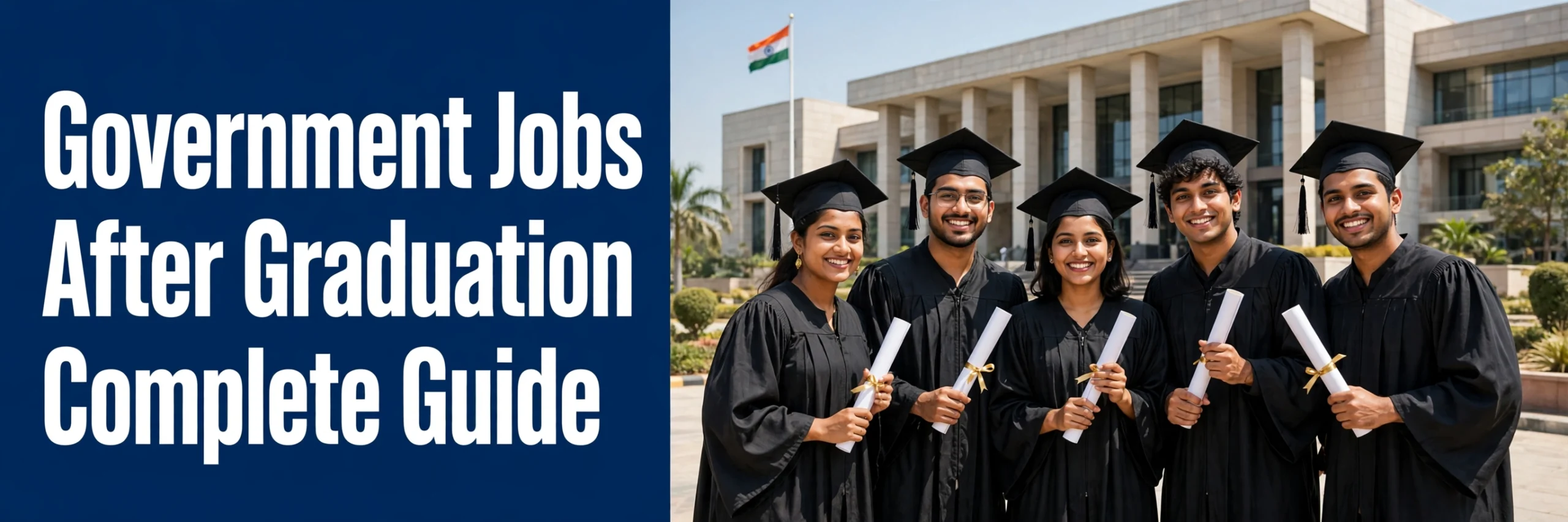
Government Jobs After Graduation: Complete Guide
Graduation opens the largest set of government jobs in India.
Officer-level posts, banking jobs, railway graduate posts, and teaching roles all accept graduates.
Almost every major recruiting body runs at least one exam for graduates.
This guide explains the main options, how to choose by stream, and how to prepare.
Why Graduation Changes Your Options
A degree is the entry ticket for Group A and Group B posts.
Many graduate exams accept any stream, so your degree subject rarely blocks you.
Some specialist posts do need a specific degree, such as engineering or law.
Always check the official notification before assuming you are eligible.
Major Government Jobs for Graduates
Graduates can target central exams, state exams, banking, railways, and defence.
The table below gives a quick map of the main options.
| Job Type | Usual Recruiting Body | Typical Work |
|---|---|---|
| UPSC Civil Services (IAS, IPS, IFS) | Union Public Service Commission | Administration, policing, and foreign service |
| SSC CGL (Assistant, Inspector, Auditor) | Staff Selection Commission | Central government office and field work |
| Bank PO and Clerk | IBPS, SBI, and RBI | Banking operations, lending, and customer service |
| Railway NTPC Graduate Posts | Railway Recruitment Boards | Station master, goods guard, and commercial work |
| State PSC Exams (SDM, DSP, Tehsildar) | State Public Service Commissions | State administration and police service |
| PSU Jobs (Engineer, Management Trainee) | NTPC, ONGC, BHEL, and others | Technical and managerial work in public sector units |
| Teaching (TGT, PGT, Assistant Professor) | State boards, UGC, and KVS or NVS | School and college teaching |
| Defence (CDS, AFCAT, CAPF) | UPSC and the armed forces | Officer roles in the Army, Navy, Air Force, and paramilitary |
| Insurance (AO, Assistant) | LIC, NIACL, and other insurers | Insurance operations and administration |
| Judiciary (Civil Judge) | State Public Service Commissions | Judicial service for law graduates |
Most of these exams run once a year, so plan your calendar early.
Choosing by Your Stream
Your graduation stream decides which specialist posts you can target.
It rarely decides whether you can apply for general graduate posts.
Arts and Humanities Graduates
Arts graduates fit UPSC, state PSC, SSC CGL, and banking exams well.
History, polity, geography, and economics overlap with these syllabuses.
Focus on general studies, English, and reasoning from day one.
Commerce and Management Graduates
Commerce graduates suit banking, insurance, and SSC CGL posts.
Accounts, economics, and finance questions come naturally to them.
Bank PO and RBI exams reward their speed with numbers.
Science Graduates
Science graduates can apply for general posts and for science-specific ones.
Posts in laboratories, research institutes, and technical departments open up.
Science graduates also do well in exams with a quantitative section.
Engineering Graduates
Engineers have the widest specialist options of all streams.
PSU jobs, Indian Engineering Services, and technical posts in railways and defence are open to them.
GATE scores are used by many PSUs for recruitment.
Law and Other Professional Graduates
Law graduates can aim for the judiciary and legal officer posts.
Medical graduates can apply for medical officer posts in government hospitals and the armed forces.
Check the notification for the exact degree and registration it asks for.
Eligibility Basics for Graduate Jobs
Most graduate recruitments ask for a bachelor’s degree from a recognised university.
Final-year students can apply for many exams, subject to the notification’s conditions.
The usual age range is 20 to 30 years, with relaxations for reserved categories.
SC, ST, OBC, EWS, and PwBD candidates get age relaxation as per government rules.
Nationality and domicile rules apply, especially in state recruitments.
Always confirm the exact age limit and qualification in the notification.
Preparation Roadmap for Graduates
Graduate exams test the same core subjects, at a higher level than 12th-pass exams.
A six to twelve month plan is enough for most of them.
Step 1: Pick Two or Three Target Exams
Do not chase every exam on the calendar.
Pick exams with overlapping syllabuses, such as SSC CGL and banking.
Study the syllabus and previous papers of each target exam first.
Step 2: Build Your Core Subjects
Revise quantitative aptitude, reasoning, English, and general awareness daily.
Use standard books and one reliable current affairs source.
Step 3: Practise with Mock Tests
Take a mock test every week from the second month onwards.
Analyse every wrong answer and note the weak topic it came from.
Increase the frequency of mocks in the last two months.
Step 4: Prepare for the Next Stages Early
Many exams have a descriptive paper, skill test, or interview after the prelims.
Start them while the written exam preparation is still running.
Step 5: Revise and Stay Consistent
Revise notes every Sunday, and keep a short daily study routine.
Consistency beats long, irregular study sessions.
Use the last two weeks only for revision and mock tests.
Documents You Will Need
Keep these documents ready before any application opens.
- Degree certificate and all semester marksheets (original and photocopies)
- Class 10 and Class 12 certificates and marksheets
- Aadhaar card and another photo identity proof
- Birth certificate or Class 10 certificate as age proof
- Caste or category certificate in the prescribed format, if applicable
- Domicile or residence certificate, if the recruitment asks for it
- Disability certificate in the prescribed format, if applicable
- Recent passport-size photographs and a scanned signature
- Experience certificate, if the post asks for work experience
- NCC or sports certificate, if you hold one and the post gives it weightage
Check name and date-of-birth spelling across all documents.
A mismatch can cause trouble at document verification.
Common Mistakes Graduates Make
| Mistake | What Happens | How to Avoid It |
|---|---|---|
| Applying for every exam at once | Your preparation stays shallow everywhere | Pick two or three overlapping exams |
| Ignoring the notification’s fine print | You may miss a stream or age rule | Read the full notification first |
| Skipping mock tests | You run out of time in the real exam | Take timed mocks every week |
| Waiting for the perfect time to start | Months pass with no preparation | Start with two hours a day, today |
| Trusting fake job notices | You may lose money to a scam | Apply only through official websites |
How to Apply for a Graduate Government Job
Most applications are online, through the recruiting body’s official website.
- Find the official notification on the recruiting body’s website.
- Read the eligibility, age limit, and fee rules carefully.
- Register with your name, mobile number, and email address.
- Fill the form, upload your photo, signature, and documents.
- Pay the fee online, if your category has to pay one.
- Submit the form and save the acknowledgement or printout.
- Download the admit card from the same website when it is released.
Keep your registration number and password safe until selection ends.
Never share your login details with anyone, including agents.
Related Government Jobs
Government Jobs After 12th Pass: Complete Guide
Government Jobs After 10th Pass: Complete Guide
How to Prepare for Government Job Exams: A Beginner’s Study Plan
Suraj is a career content writer at SrJobHut, covering government jobs, private jobs, internships, and recruitment updates. He focuses on providing clear, useful, and easy-to-understand information to help job seekers explore career opportunities.

1 thought on “Government Jobs After Graduation: Complete Guide”