

How to Prepare for Government Job Exams: A Beginner’s Study Plan
Government job exams attract lakhs of candidates every year in India.
Many beginners feel lost because they do not know where to start.
A clear study plan turns that confusion into steady daily progress.
This guide gives you a simple plan you can follow from day one.
Understand the Exam Pattern and Syllabus First
Every exam has its own pattern, so never start studying blindly.
First, download the official syllabus from the recruiting body’s website.
Read it fully and note the subjects, topics, and marks for each section.
Check how many stages the exam has, such as prelims, mains, and interview.
Also note the time limit, negative marking, and qualifying sections.
Knowing the pattern helps you spend time on what actually matters.
Many beginners waste months on topics that carry almost no marks.
Choosing the Right Exam
Do not prepare for every exam at once, as that leads nowhere.
Pick one main exam that matches your qualification and age limit.
Well-known exams include those by SSC, UPSC, RRB, IBPS, and state commissions.
Each of these has a different syllabus, so choose before you begin.
Check the eligibility rules in the official notification before deciding.
Once you choose, keep other exams as backup options, not equal priorities.
A single clear target keeps your preparation focused and your mind calm.
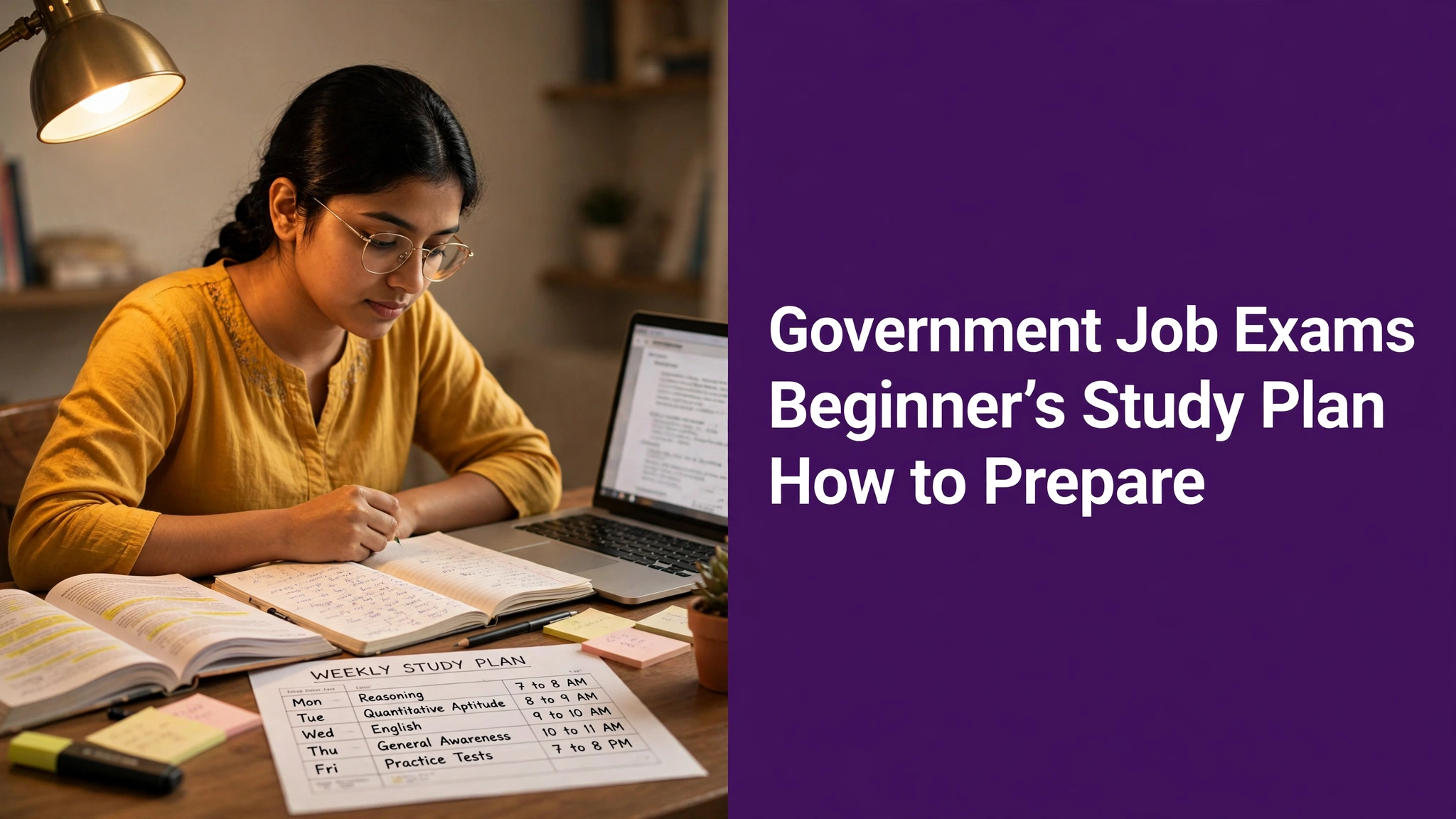
Building a Realistic Timetable
A timetable works only if you can actually follow it every day.
Start with the hours you honestly have, not the hours you wish you had.
Most working aspirants manage four to six hours of study daily.
Full-time aspirants can aim for six to eight hours with proper breaks.
Divide your day into fixed slots for each subject.
Keep one slot every day for revision of what you studied before.
Study the same subject at the same time each day to build a habit.
Review your timetable every Sunday and fix what is not working.
| Day | Morning (2 hours) | Afternoon (2 hours) | Evening (2 hours) |
|---|---|---|---|
| Monday | Quantitative Aptitude | Reasoning | Current Affairs |
| Tuesday | English | Quantitative Aptitude | General Knowledge |
| Wednesday | Reasoning | English | Revision |
| Thursday | Quantitative Aptitude | General Knowledge | Current Affairs |
| Friday | English | Reasoning | Mock Test Analysis |
| Saturday | Full Mock Test | Mock Test Analysis | Weak Topics |
| Sunday | Weekly Revision | Previous-Year Papers | Rest and Planning |
Adjust this sample timetable to match your own daily routine.
Subject-Wise Preparation
Most government exams test four main areas in the written stage.
These are quant, reasoning, English, and general knowledge.
Give more time to your weakest subject, not your favourite one.
Cover the basics of all subjects before moving to advanced questions.
Quantitative Aptitude
Quant tests your speed and accuracy with numbers.
Start with basic arithmetic, percentages, ratios, and averages.
Learn short-cut methods only after you understand the basic concept.
Practise at least twenty questions daily from each topic you cover.
Keep a notebook of formulas and revise it every week.
Reasoning
Reasoning tests your logic, not your memory.
Common topics include puzzles, series, coding-decoding, and seating arrangements.
Practise one type of question at a time until you feel confident.
Time yourself, because reasoning questions eat up exam time fast.
Do not skip reasoning; it is often the most scoring section.
English
English tests grammar, vocabulary, and reading comprehension.
Read a newspaper or a simple English article for thirty minutes daily.
Learn five new words every day and use them in a sentence.
Revise grammar rules like tenses, articles, and prepositions regularly.
Practise comprehension passages under a time limit.
General Knowledge and Current Affairs
General knowledge covers history, geography, polity, and science.
Read NCERT school books for a strong base in these subjects.
For current affairs, follow one reliable newspaper or monthly magazine.
Make short notes of important events with their dates.
Revise current affairs of the last six months before the exam.
Do not try to read everything; focus on repeated and important topics.
Mock Tests and Previous-Year Papers
Mock tests show you where you truly stand.
Start taking topic-wise tests after finishing the basics of a subject.
Move to full-length mock tests once you cover most of the syllabus.
Always take mock tests in exam-like conditions with a timer.
After every test, spend as much time analysing it as taking it.
Note your weak topics and revise them before the next test.
Previous-year papers show the real level and style of questions.
Solve at least five previous-year papers before your exam.
They also reveal which topics repeat year after year.
Revision Strategy
Revision is what turns studied topics into remembered answers.
Revise every topic within a week of first studying it.
Then revise it again after one month, and once more before the exam.
Keep your notes short, because long notes are never revised.
Use one notebook per subject for formulas, rules, and key facts.
Revise current affairs and general knowledge more often than other subjects.
They fade from memory fastest if you do not repeat them.
Reserve the last month before the exam only for revision and mock tests.
Do not start any brand-new topic in that final month.
Common Beginner Mistakes
Many beginners fail not from lack of hard work, but from wrong habits.
Buying too many books is the first mistake; one good book per subject is enough.
Studying without a timetable is the second; random study gives random results.
Skipping mock tests is the third; you cannot improve what you never measure.
Ignoring weak subjects is the fourth; the exam tests all sections equally.
Comparing yourself with others online is the fifth; it only creates stress.
Studying for twelve hours one day and zero the next is the sixth.
Consistency beats intensity in a long preparation journey.
A Beginner’s First-Week Checklist
Use this checklist to start your preparation in an organised way.
- Download the official syllabus and exam pattern of your chosen exam.
- Check the eligibility rules in the official notification.
- Buy or arrange one standard book for each subject.
- Make a daily timetable with fixed slots for every subject.
- Start a notebook for formulas, rules, and short notes.
- Begin reading a newspaper daily for current affairs.
- Solve a few questions from each subject to find your weak areas.
- Fix a weekly revision day and stick to it.
Stay Consistent and Motivated
Government exam preparation is a marathon, not a sprint.
Most successful candidates prepare for many months before clearing an exam.
There will be days when your mock test scores fall.
That is normal, and it does not mean you are failing.
Track your progress weekly instead of judging yourself daily.
Small improvements each week add up to a big change over months.
Take short breaks and sleep well; a tired mind learns nothing.
Talk to other aspirants, but do not copy their timetable blindly.
Your plan should fit your life, your speed, and your strengths.
Keep showing up every day, and the result will follow your effort.
Related Government Jobs
- How to Apply Online for Government Jobs in India: Step-by-Step Guide
- Documents Required for Government Job Applications: Complete Checklist
- What Is a Merit List and Cut Off in Government Recruitment?
- How to Prepare for Government Job Interviews: Questions, Dress Code and Confidence
How to Fill OMR Sheets and Computer Based Tests Without Mistakes

Suraj is a career content writer at SrJobHut, covering government jobs, private jobs, internships, and recruitment updates. He focuses on providing clear, useful, and easy-to-understand information to help job seekers explore career opportunities.




3 thoughts on “How to Prepare for Government Job Exams: A Beginner’s Study Plan”